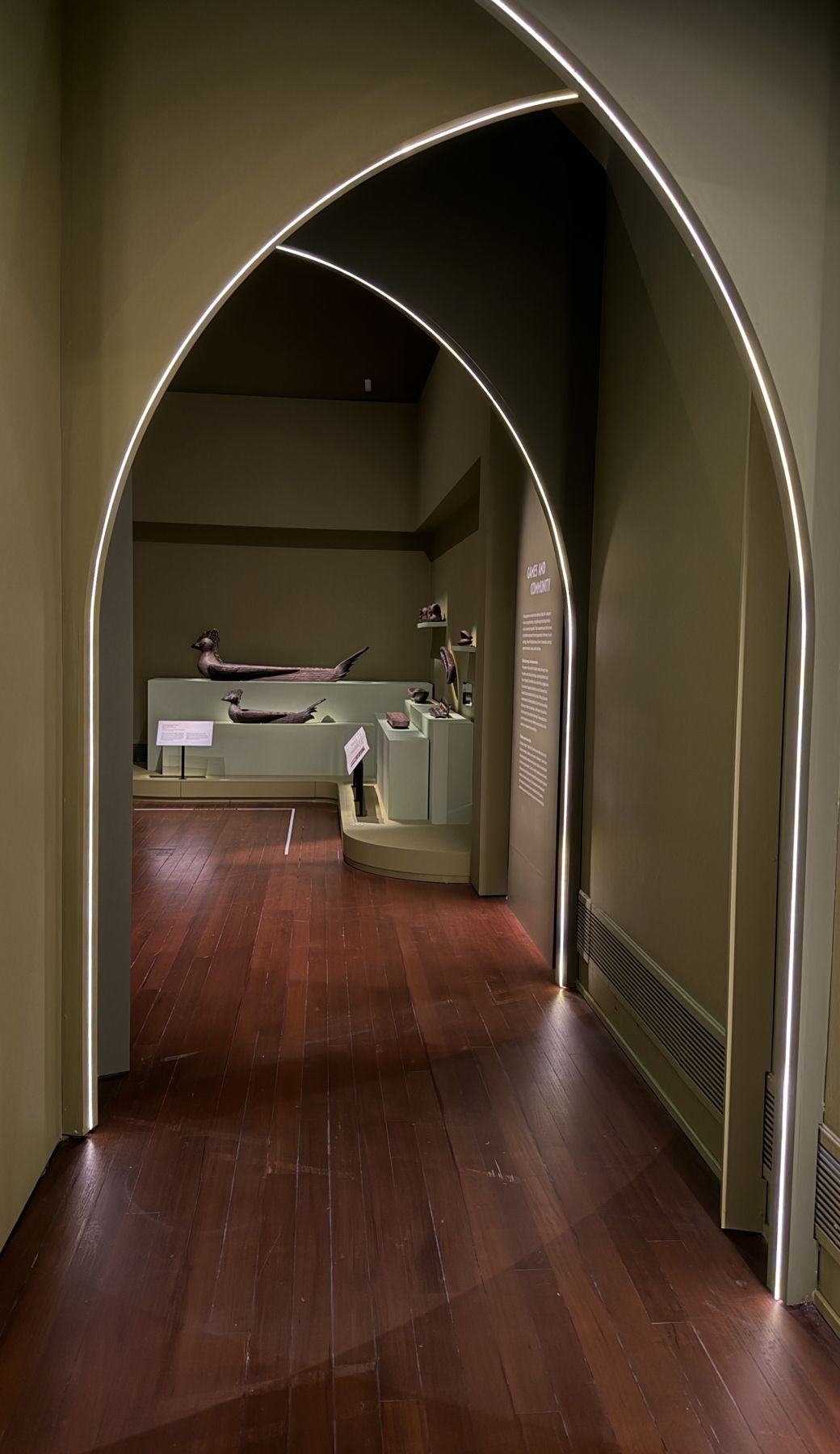
Lit pointed archways leading into the Games and Community gallery at the Asian Civilisations Museum

Travels · Singapore

Singapore,
February 2026

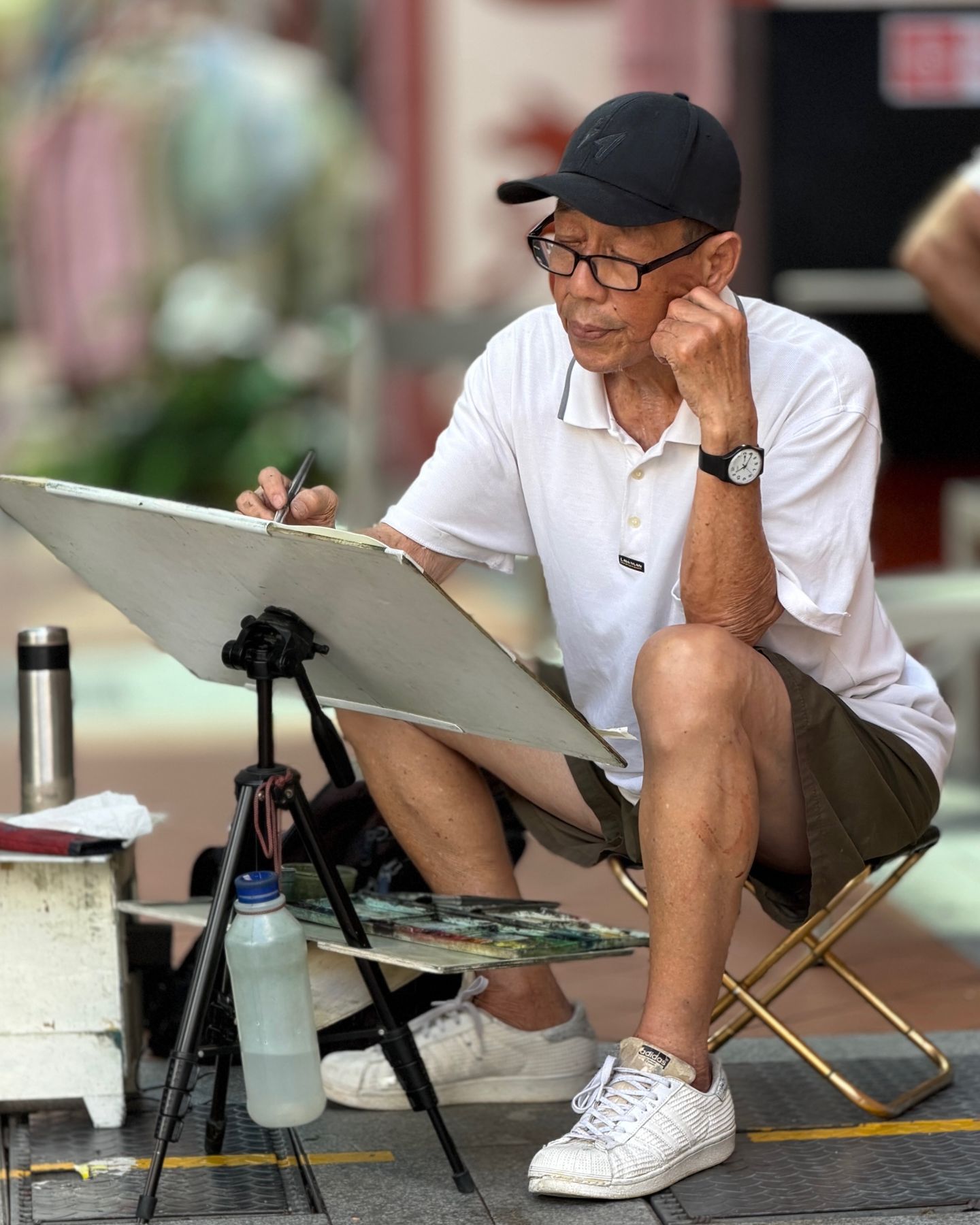
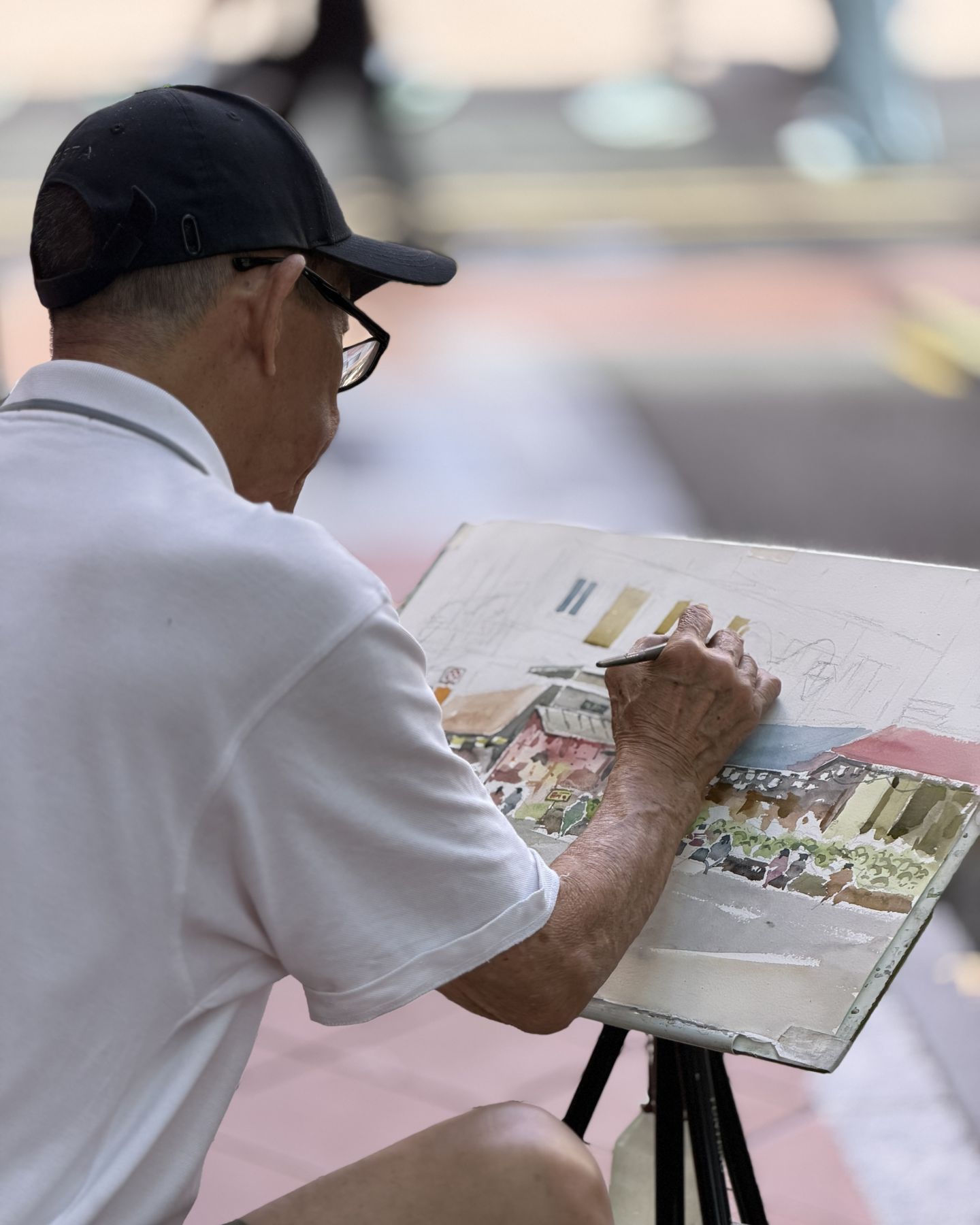
Three days in February. Most of these pictures were taken inside the Asian Civilisations Museum, on the river at Empress Place. The rest came from the streets of Chinatown, where a man was painting the corner of Sago Street in watercolour.


Why Singapore

Debby's board responsibilities can take her anywhere in the world. I was fortunate enough to join her on a business trip to Singapore. We flew from Miami to Dubai and then from Dubai to Singapore. Staying at the Raffles Hotel was a treat. Nostalgic too. When my father was shipped to Burma as part of the post-World War II clean-up, he went through Singapore and got to see the Raffles Hotel. I'm quite sure the Army didn't house him there, even for one night, if that's how long he was in Singapore.

My parents stayed there many years later, en route to my brother Andy's home in New Zealand.

As a side note, advice on how to get back home was prescient. We flew from Singapore to San Francisco and then on to Fort Lauderdale. The following day the USA bombed Iran.

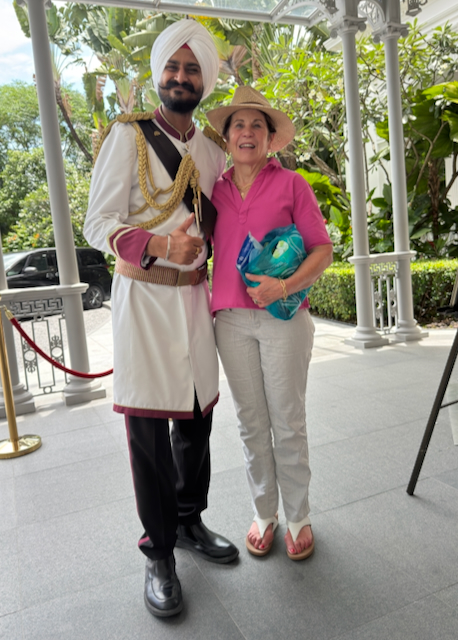
Debby with a Raffles Hotel doorman in his white uniform and turban
Debby with one of the Raffles doormen.

Gods, games and goods for export

The labels below follow the museum's own wording, lightly trimmed.

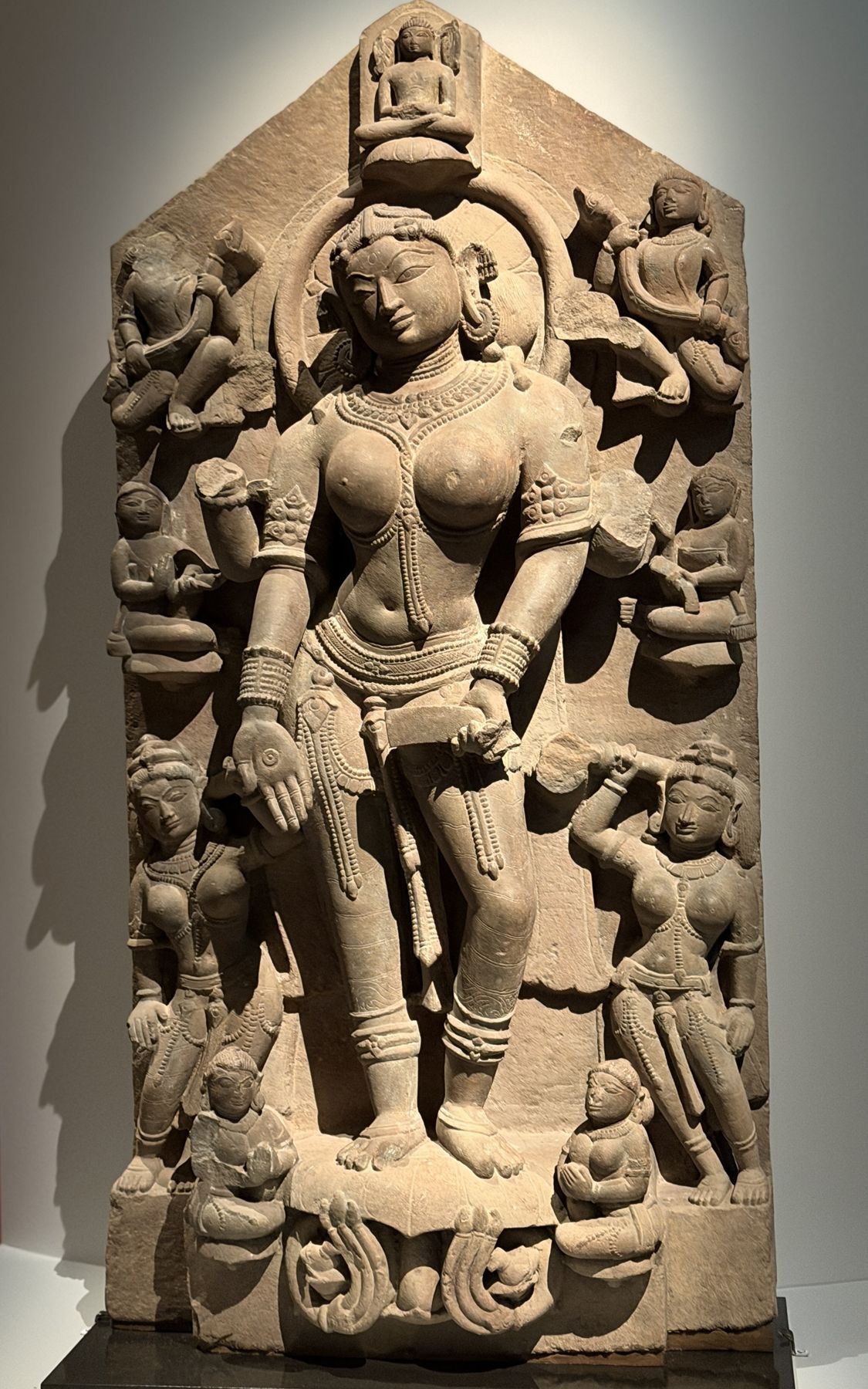
Sandstone relief of the goddess Sarasvati holding a manuscript, a seated Jina above her

Sarasvati

India, Rajasthan, around 11th centurySandstone

We know this is Sarasvati, goddess of learning and music, by the manuscript in her left hand. The Jina at the top ties her to the Jain religion.

She's better known as a Hindu goddess, but her cult is popular in Jainism too, where knowledge is the main road to salvation. She's a river goddess, named for the Sarasvati, which in ancient times mattered as much as the Ganges and the Yamuna.

Jains, Hindus and Buddhists all revere her as the goddess of knowledge, learning, speech, poetry and music. In Jainism she has a name of her own. She's honoured as Shrutadevi, the goddess of scripture, and she presides over the teachings of all 24 Jinas. Jain tradition goes further still: the twelve core scriptures are her limbs, and the fourteen older texts are her ornaments.

She stopped me in my tracks. I'm always drawn to the places where different faiths meet. So often religion divides us. Here's one goddess honoured by three of them, a quiet reminder of how much we share, and how little we need to fight about.
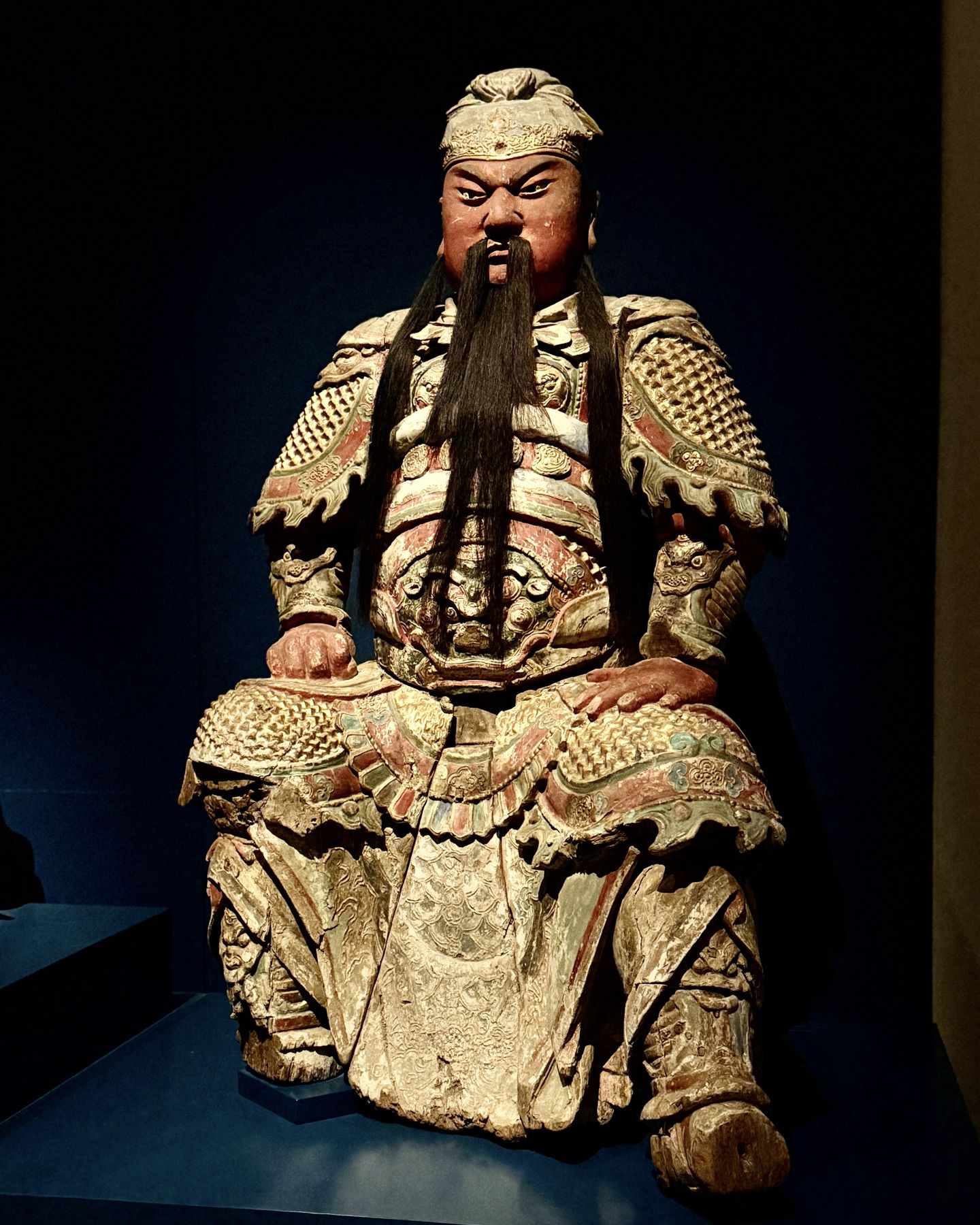
Painted wooden statue of Guan Gong seated in armour, with a long beard of real hair

Guan Gong

China, Shanxi province, Ming dynasty (1368 to 1644)Painted wood

A hero who helped revive Han rule in the 3rd century, known for courage and for serving his master with unquestioned loyalty. He became a Buddhist deity as early as the mid-6th century and was formally linked to Daoism under the Song (960 to 1279).

By the Ming period his cult was so widespread that emperors installed his image as a guardian of Buddhist temples.

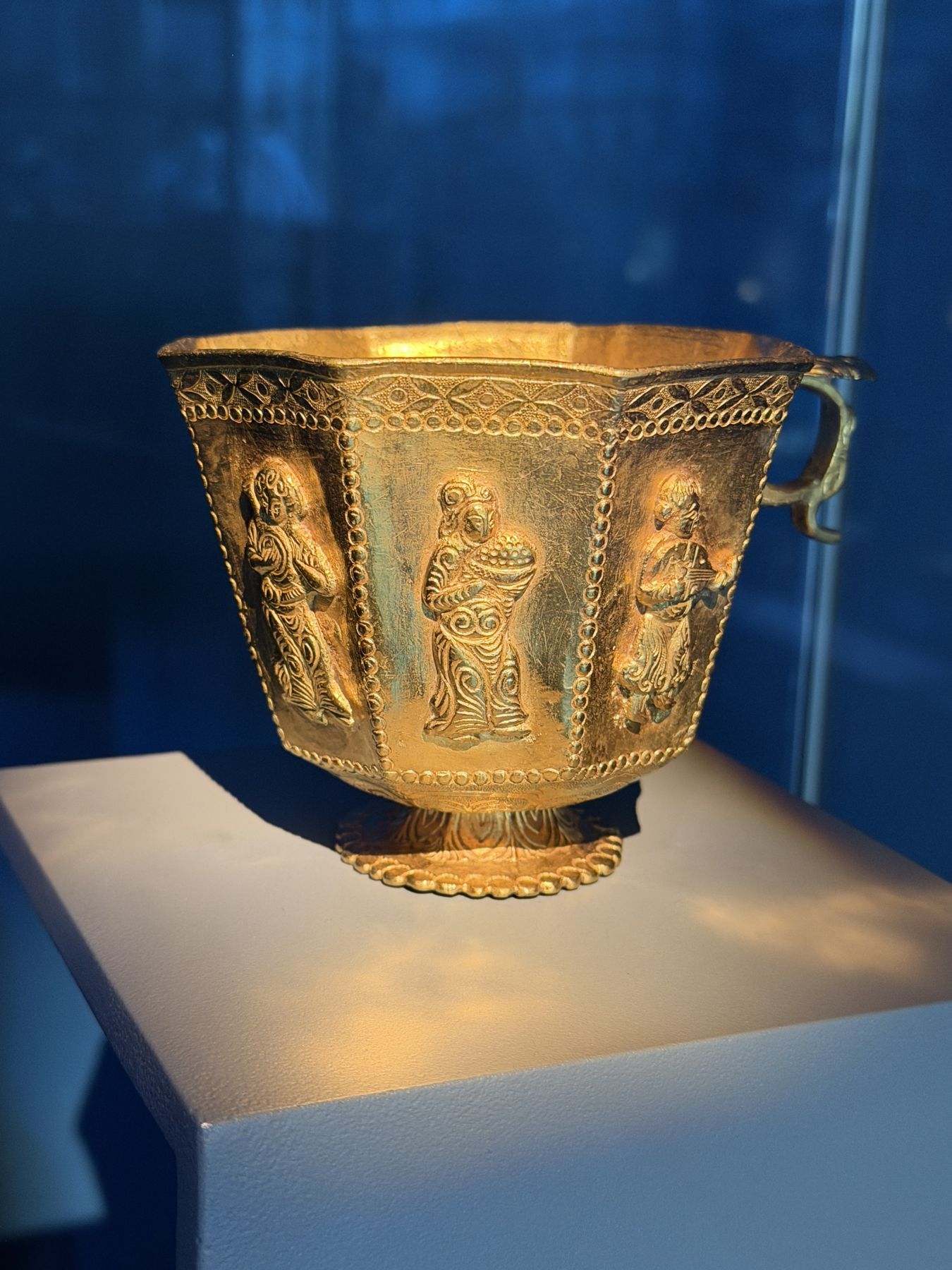
Octagonal gold cup, each panel embossed with a standing figure, lit against a deep blue case

Octagonal cup with musicians and a dancer

China, around the 830sGold

Long, curly hair and billowing clothes mark the figures as Central Asian. Entertainers like these were popular in China in the 8th and 9th centuries. The bearded faces on the handle are plainly foreign too.

Given the theme of revelry, the cup was most likely used for wine.

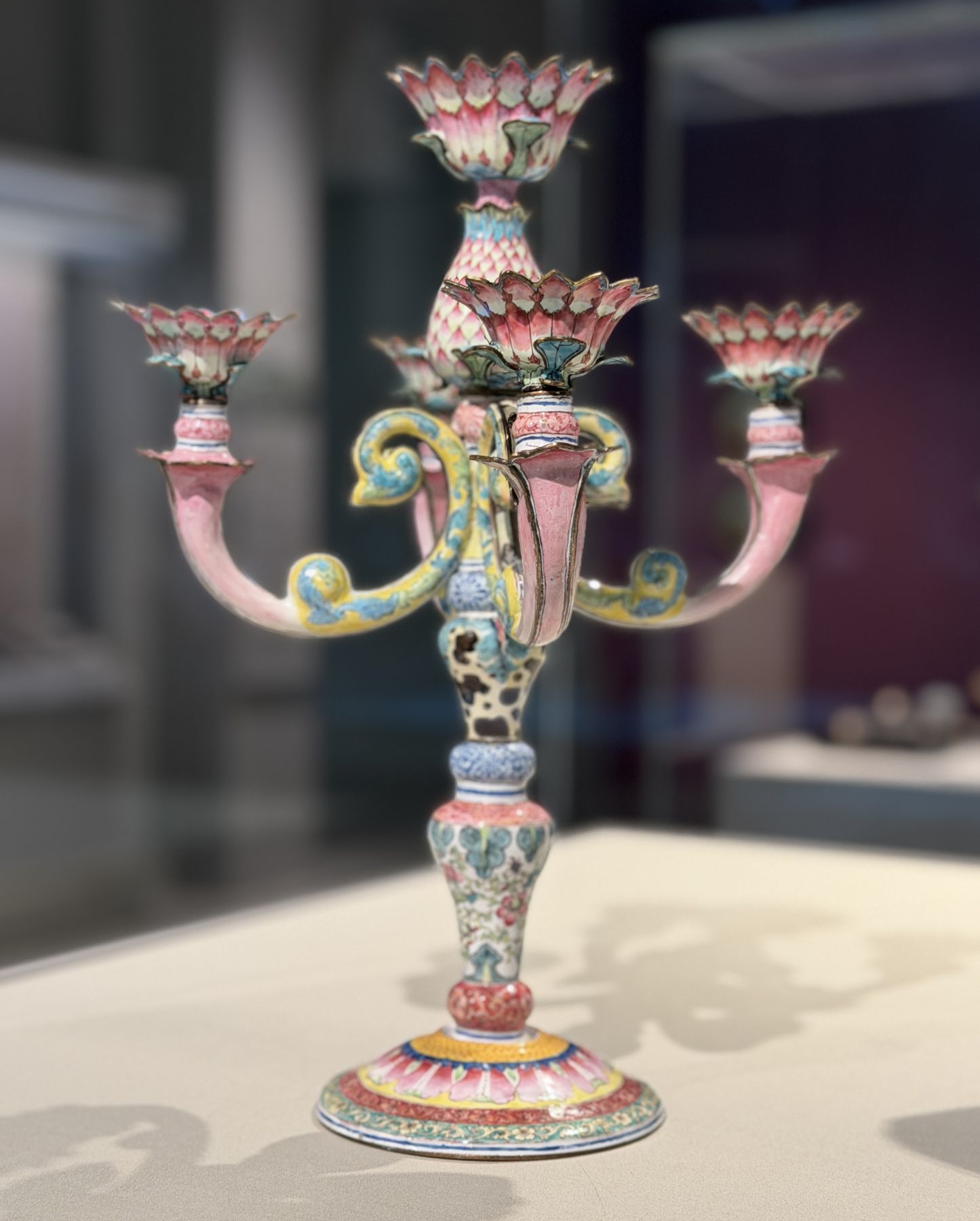
Painted enamel candelabra in pink, yellow and turquoise with five lotus-shaped candle cups

Candelabra

China, Guangzhou, 18th centuryPainted enamel on copper

Made for dining tables in Europe and America, but most of the design is plainly Chinese. The stem carries five candleholders shaped like lotuses.

The form was made in copper, coated with pigments holding ground glass, then fired to give a bright, hard-wearing enamel.

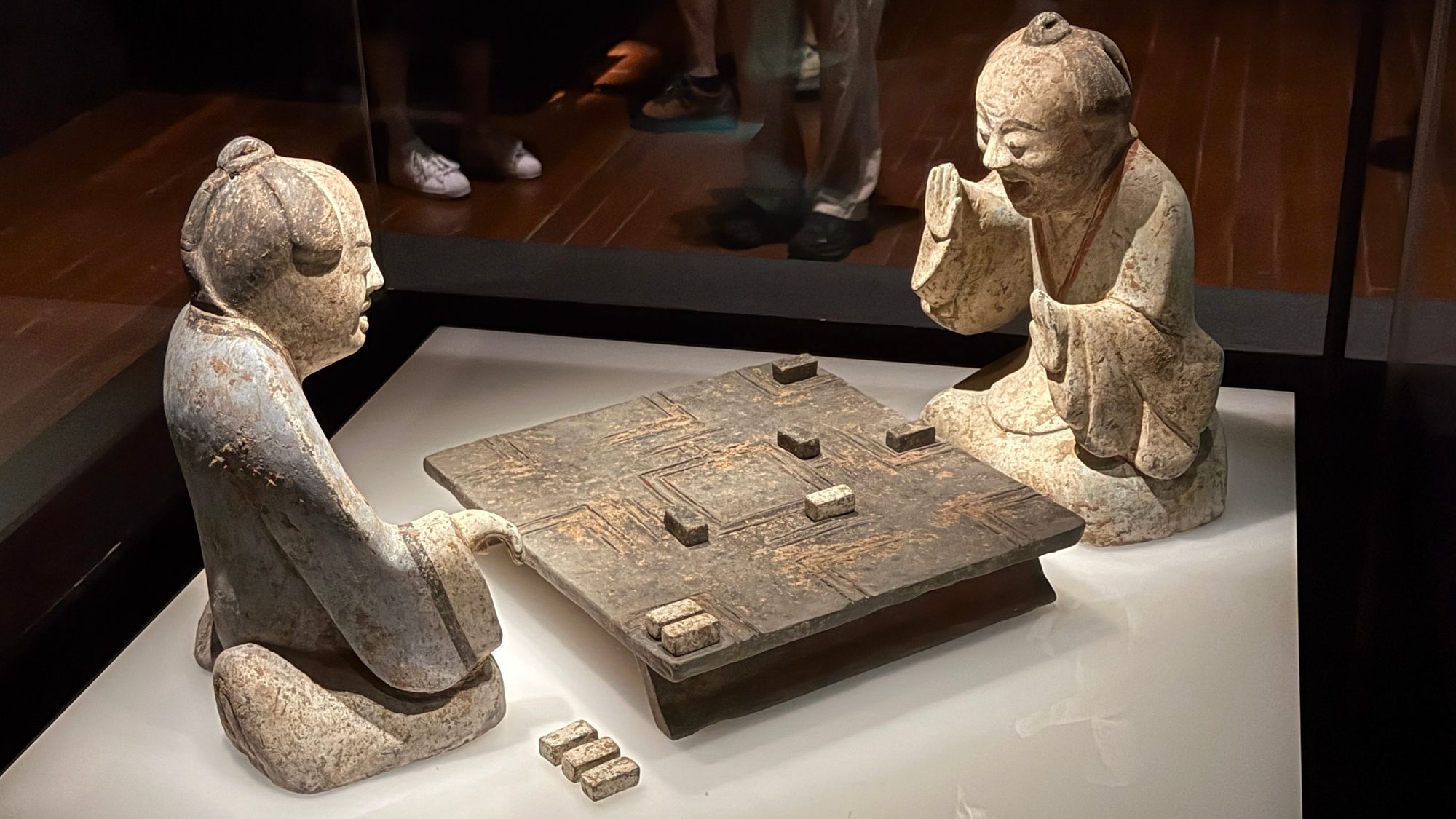
Two earthenware Liubo players kneeling either side of their board, one raising his hand as if calling a move

Seated Liubo players with board and pieces

China, Han dynasty, early 3rd centuryEarthenware

Liubo, "six rods", is the earliest game preserved in China's archaeological record. Its rules have long since been lost, but it was hugely popular from about 350 BC before fading into obscurity in the third century.

Murals, ceramic models and written records show it was played by everyone from emperors to commoners. Surviving pieces tell us that players threw six double-sided rods to move their pieces around a board.

Mostly a game of chance. The board probably drew on divination and cosmological diagrams, which may have linked it to the spirit world.

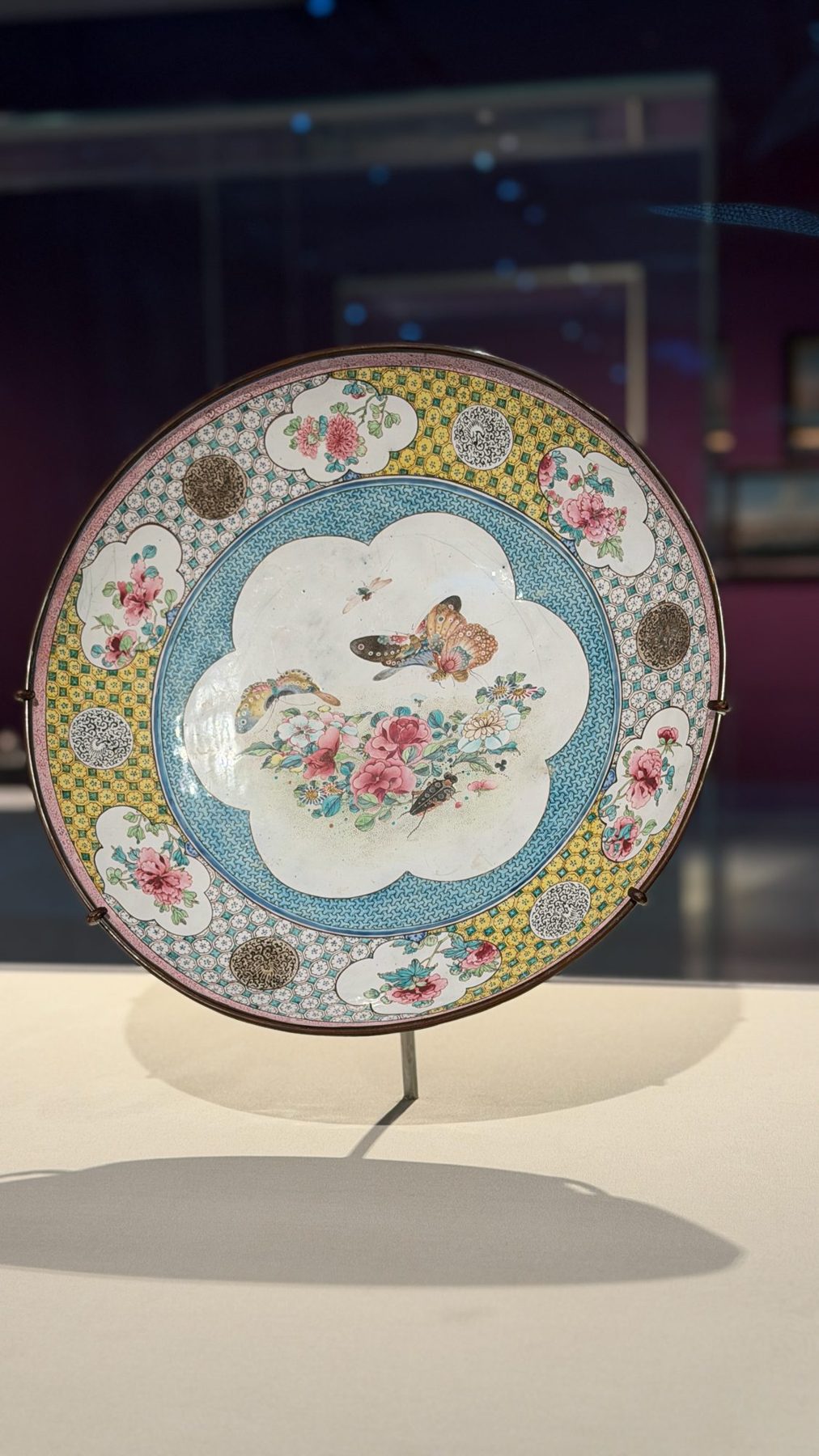
Painted enamel dish with flowers and a butterfly in a pale blue border

Dish

China, Guangzhou, 18th centuryPainted enamel on copper

The fine shading and delicate, watercolour-like flowers and butterflies show how good the Guangzhou enamellers were. The base is painted with a peony against a bright yellow ground decorated with the "cracked ice" pattern.

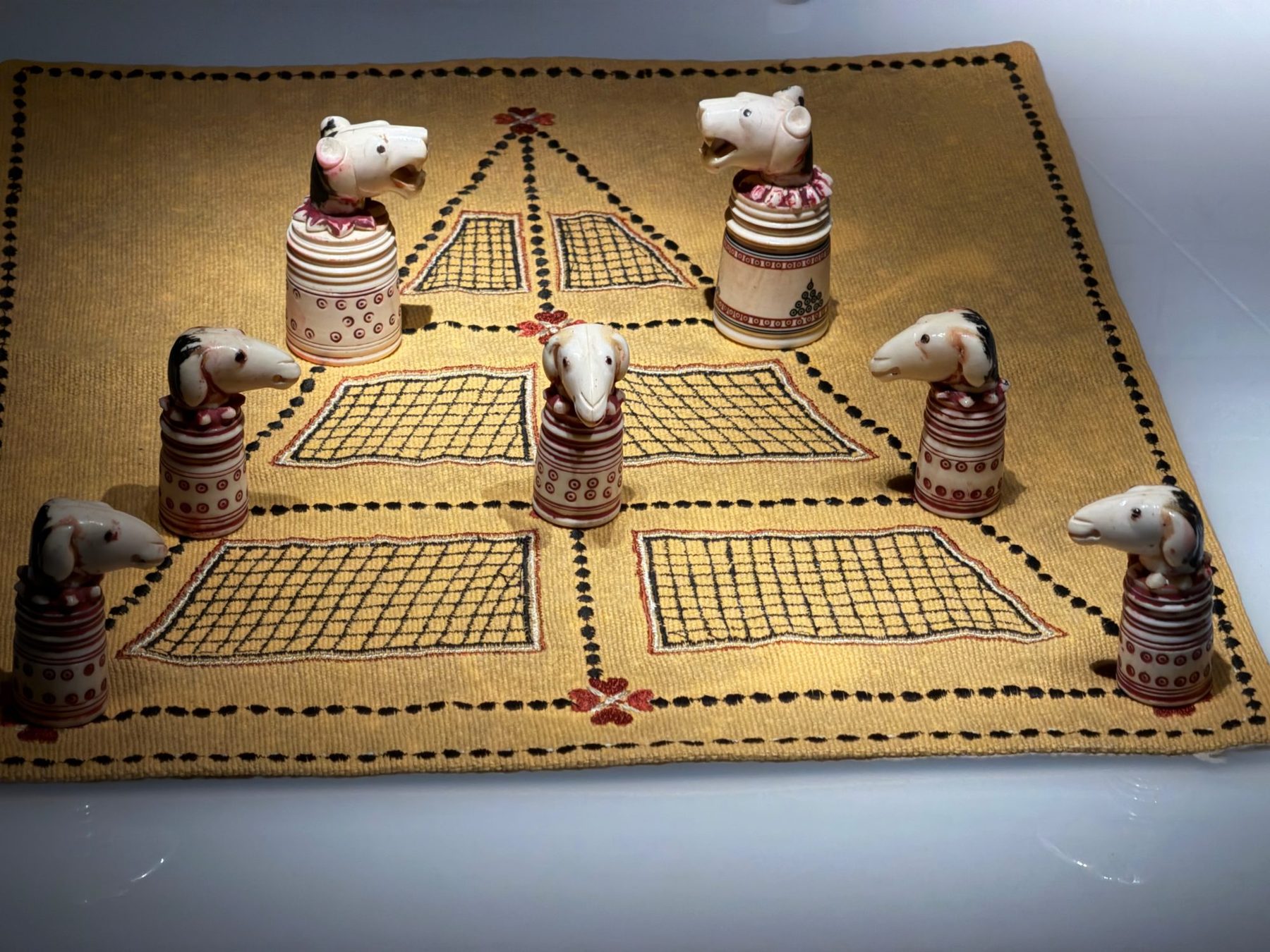
Ivory tiger and goat pieces standing on an embroidered cloth board

Tigers and Goats

India, 18th or 19th centuryStained ivory, cloth

Played from southern India to Indonesia under many names, with the rules much the same everywhere. Two tigers try to capture a flock of goats by jumping over them to an open point. The goats move one space at a time and win by hemming the tigers in.


A painter on Sago Street

An older man in a white polo shirt and black cap on a folding stool at a tripod easel, brush in hand Over the painter's shoulder: a half-finished watercolour of shophouses and a busy street

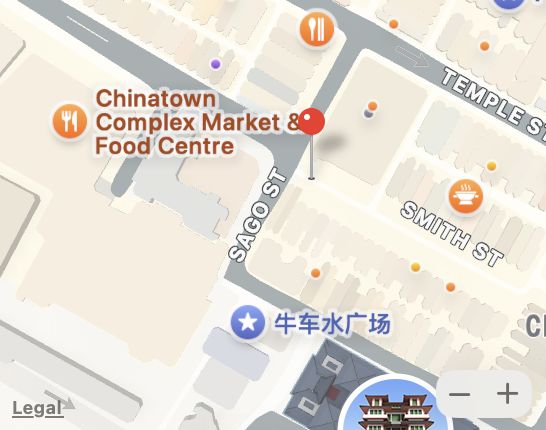
Just as Sago Street turns at Trengganu Street, you see this riot of colour. Of course, nothing unusual about that. The whole of Chinatown is colourful.

I have a soft spot for anyone who can create with paper, pencil or paint. What mental journey takes someone from drawing stick figures to finished works of art? It intrigues me. Flat or in the round, it hardly matters, nor whether the medium is canvas, paper, stone or metal.

Street map with a pin at the corner of Sago Street and Trengganu Street, beside Chinatown Complex Market and Food Centre
Where he'd set up, by Chinatown Complex Market and Food Centre.

Along the river at Qingming

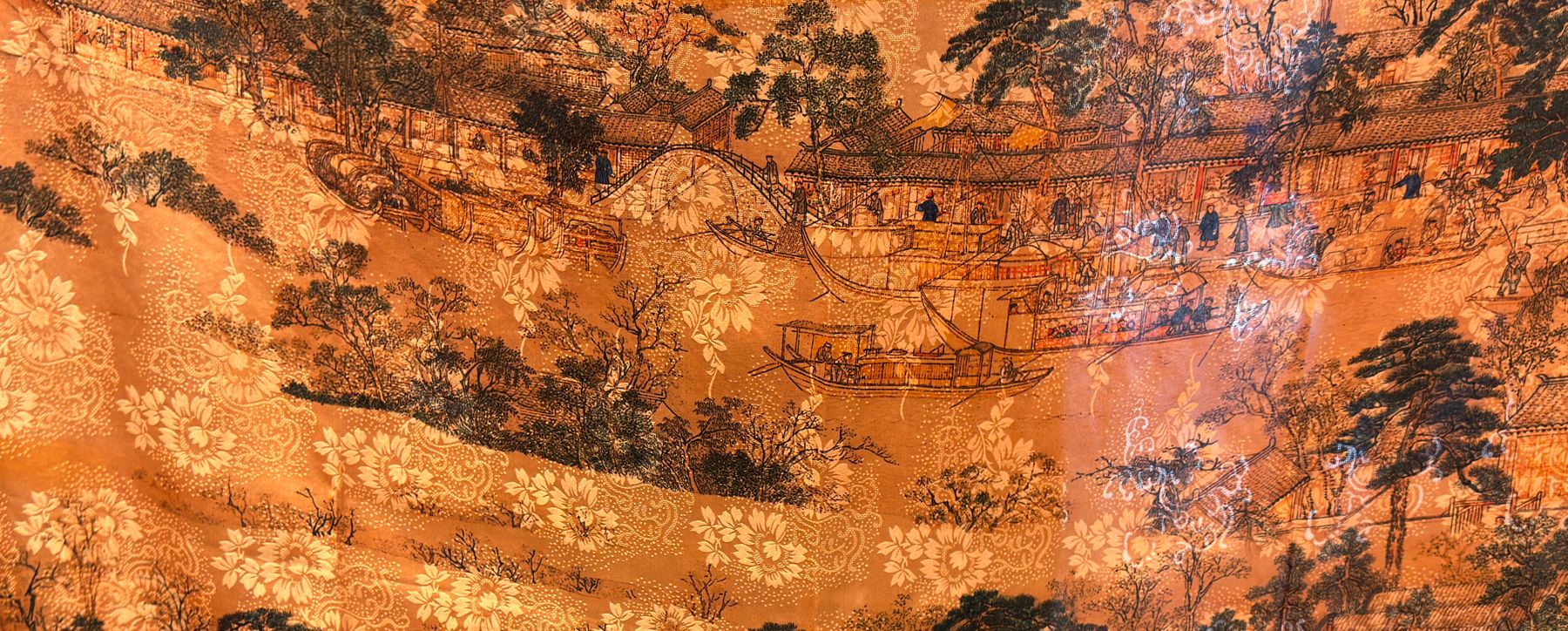
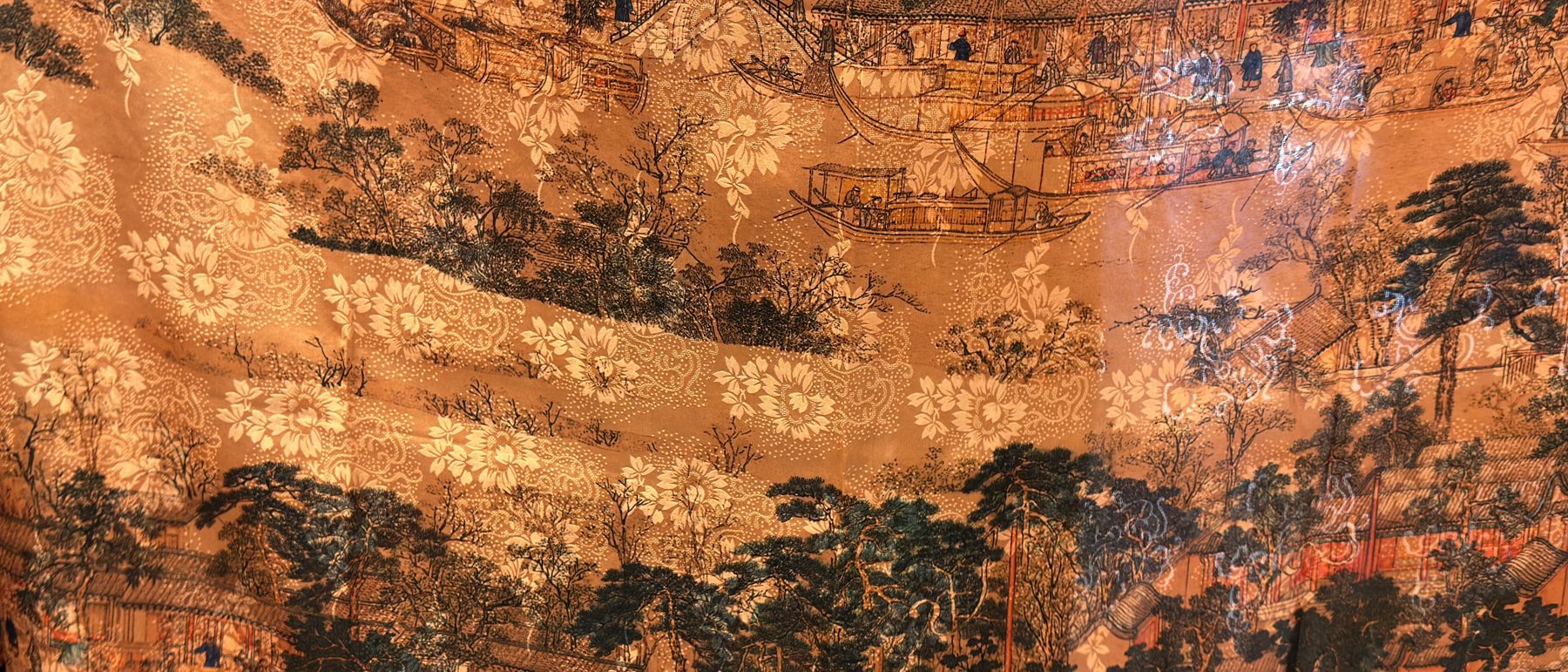
Detail from a silk interpretation of "Along the River During the Qingming Festival", after Zhang Zeduan (Song dynasty, around 1085 to 1145). The original scroll, one of China's best-loved paintings, follows a single busy day in the imperial capital: merchants, travellers, boats and bridges in one unbroken panorama.

Silk printed with a river scene: an arched bridge, moored boats and crowds along the bank, over a woven flower pattern
A second view of the silk showing boats on the river and pine trees on the lower bank
The woven peony ground shows through the printed scene.

I found the silk in a shop on Smith Street, just round the corner from the painter. As usual with me, it was the history behind the piece that caught my eye, as much as its beauty. I didn't buy it. I just admired it up close, and now from afar.

All travels